
Germany is one of Europe’s major dairy producers, and the composition of its cattle population reflects several decades of selection pressure toward high milk yield and feed efficiency. Two breeds dominate the landscape: the Holstein-Friesian in the north and center, and the dual-purpose Fleckvieh (German Simmental) concentrated in Bavaria and parts of Baden-Württemberg.
This article describes the principal dairy breeds found on German farms, drawing on publicly available information from breed associations and agricultural institutions.
Holstein-Friesian
The Holstein-Friesian is the most widely kept dairy breed in Germany and in much of the world. The breed originated in the provinces of North Holland and Friesland, and was refined through selection in North America before being reintroduced to European breeding programs in the second half of the 20th century.
In Germany, the breed is registered and evaluated by regional breeding associations, which operate under the umbrella of Rinderzucht Deutschland e.V. Performance data is collected through the milk recording system administered by the Landeskontrollverbände (regional herd recording organizations).
Key Characteristics
| Trait | Description |
|---|---|
| Coat pattern | Black and white (occasionally red and white) |
| Body type | Angular, deep-bodied, with prominent ribs |
| Primary use | Milk production |
| Lactation length | Standard 305-day lactation used for comparison |
| Feed conversion | High efficiency relative to body mass |
Holstein-Friesian cows in Germany are primarily kept in loose housing systems with cubicle (free stall) accommodation. Tie stalls remain on some smaller operations, though their use has declined due to animal welfare regulations. Milking is typically carried out two or three times daily in herringbone or parallel parlors; automatic milking systems (voluntary milking systems) have seen increasing adoption on medium-sized farms.
German Fleckvieh (Simmental)
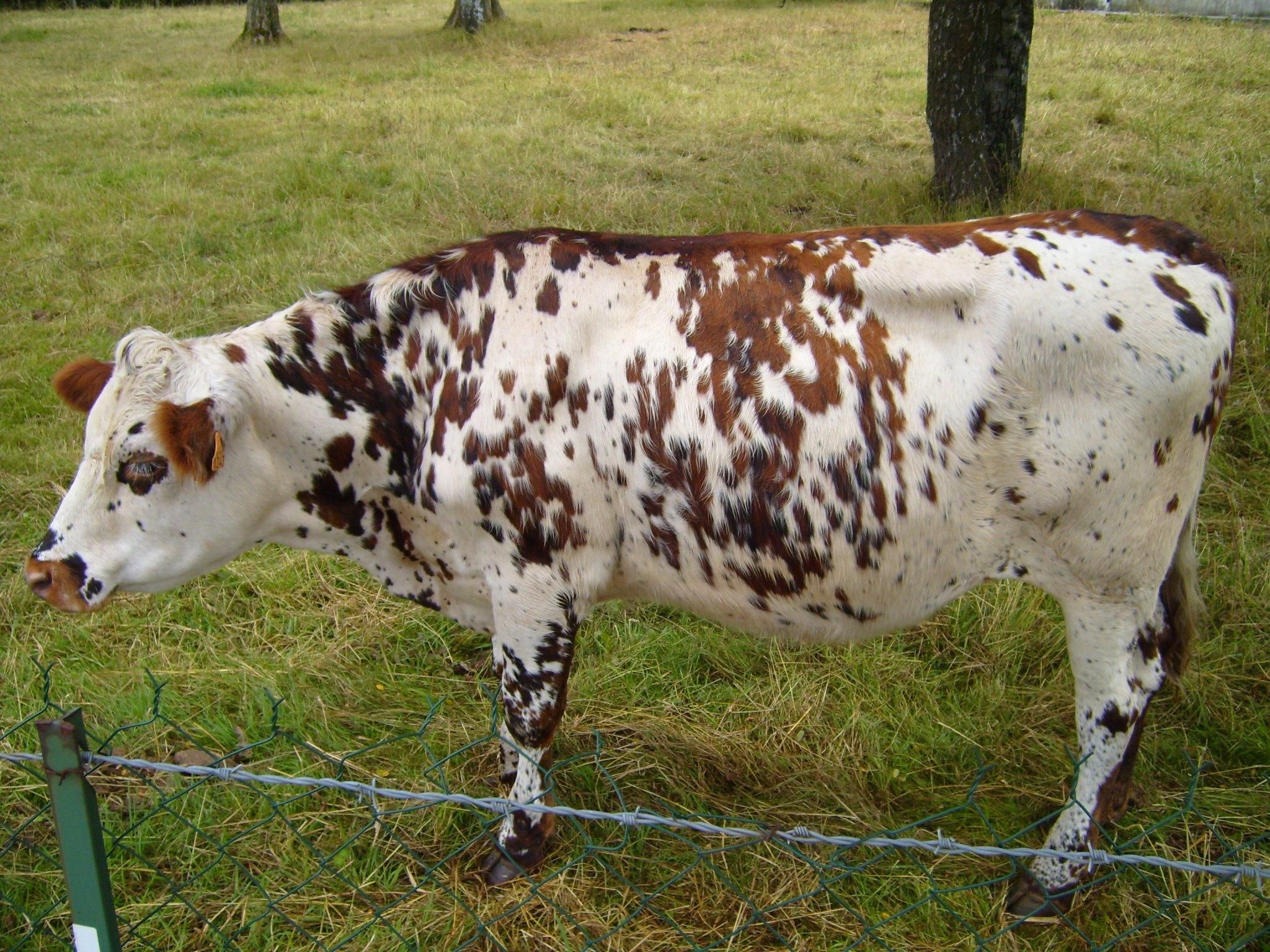
The Fleckvieh, internationally known as the Simmental, is a dual-purpose breed with significant populations in Bavaria, Austria, and Switzerland. In Germany, it is the second-largest cattle breed by registered population and the dominant breed in the southern federal states.
The breed is registered through the Bayerische Herdbuch Gesellschaft (BHG) and similar organizations. Selection in German Fleckvieh breeding considers both milk traits and beef traits simultaneously, using a combined breeding value index that weights both performance dimensions.
Milk and Beef Profile
Fleckvieh cows produce milk with higher fat and protein content on average compared to Holstein-Friesian, which is advantageous for cheese production. The breed also shows better body condition scores at calving and is considered more robust in pasture-based systems.
Male Fleckvieh calves are frequently raised for beef rather than being considered a byproduct of the dairy enterprise, which has economic significance particularly in Bavaria where local beef markets value this breed.
Brown Swiss (Braunvieh)
The Brown Swiss, known in Germany as Braunvieh, maintains a smaller but consistent population, particularly in the Alpine foothills of Bavaria and in some parts of Baden-Württemberg. The breed is valued for its milk protein content and longevity.
German Braunvieh breeding is coordinated through the Bundesverband Deutscher Braunviehzüchter. The breed has undergone partial introgression from North American Brown Swiss genetics since the 1970s, which increased milk volume at some cost to the original dual-purpose character.
Red Holstein and Other Minor Breeds
Red Holstein (Rotbunt) cattle represent the red-and-white color variant of the Holstein-Friesian breed. They are kept on farms where the red gene is preferred or where historic regional breeds have been upgraded. Rotbunt cattle are registered separately in some breeding programs but are genetically close to black-and-white Holstein.
The Deutsche Schwarzbunte (original German Black Pied) represents an older type of German dairy cattle that preceded intensive selection from North American Holstein lines. Small populations are maintained by breed preservation societies as a genetic resource.
Performance Recording and Data Infrastructure
Milk recording in Germany follows the A4 recording method prescribed by the International Committee for Animal Recording (ICAR). Cows are tested monthly by certified milk recorders; the data is processed by regional associations and used to calculate official breeding values.
Breeding value estimation for dairy traits in Germany uses BLUP (Best Linear Unbiased Prediction) methodology, increasingly supplemented by single-step genomic evaluation. The Vereinigte Informationssysteme Tierhaltung (VIT) in Verden coordinates national-level data processing for the Holstein breed.
Regional Distribution
The geographic distribution of dairy breeds in Germany largely follows the historical boundaries of regional agricultural traditions:
- Northern Germany (Schleswig-Holstein, Lower Saxony, North Rhine-Westphalia): predominantly Holstein-Friesian
- Bavaria: predominantly Fleckvieh, with regional Holstein presence
- Baden-Württemberg: mixed, with Fleckvieh, Braunvieh, and Holstein
- Eastern Germany (former GDR states): Holstein-Friesian, often in larger industrial-scale operations
Further Reading
- Rinderzucht Deutschland e.V. — national coordination body for cattle breeding
- Bundesministerium für Ernährung und Landwirtschaft (BMEL) — federal agricultural ministry publications
- International Committee for Animal Recording (ICAR) — international recording standards