
Beef cattle production in Germany occupies a different position in the agricultural structure compared to dairy farming. Dedicated beef breeds are kept primarily in suckler cow systems, where calves are raised by their dams on pasture or in loose housing before entering a finishing phase. The sector is considerably smaller than dairy in terms of animal numbers, but it plays an important role in land utilization, particularly on grassland areas not suited to arable crops.
This article describes the major beef cattle breeds present in Germany, the framework for performance testing, and the organizational structure of German beef cattle breeding.
Structure of Beef Cattle Breeding in Germany
Beef cattle breeding in Germany is organized through regional breeding associations, many of which handle multiple breeds. At the national level, Rinderzucht Deutschland e.V. coordinates data exchange and represents German breeders in international fora.
The legal basis for breeding activities is the German Livestock Act (Tierzuchtgesetz), which regulates studbook management, performance testing, and the approval of bulls for artificial insemination. Performance testing for beef bulls involves evaluation of growth rate, feed conversion efficiency, and conformation traits, typically carried out at centralized testing stations.
Charolais
The Charolais breed originates from the Charolles region of Burgundy, France, and is one of the most widely distributed beef breeds globally. In Germany, Charolais cattle are present across most federal states, with particularly active breeding populations in Mecklenburg-Vorpommern, Brandenburg, and parts of Bavaria.
Charolais: Key Breed Traits
| Trait | Notes |
|---|---|
| Coat color | Cream-white to pale wheat |
| Muscling | Heavy, double-muscled appearance in some lines |
| Frame size | Large; cows 650–850 kg typical |
| Calving ease | Can be challenging; crossbreeding use common |
| Primary use | Terminal sire; crossbreeding |
Charolais bulls are frequently used as terminal sires in crossbreeding programs, where the objective is maximum growth rate and carcass weight rather than the production of replacement heifers. The breed’s tendency toward calving difficulty means it is generally avoided as a straight-breeding option on maiden heifers.
Hereford

The Hereford breed, originating in Herefordshire, England, is one of the oldest recognized beef breeds and maintains a stable presence in Germany. Its distinguishing characteristic is the red body coat with a white face, which is consistent across the breed.
Characteristics Relevant to German Conditions
Hereford cattle are valued for their docility, early maturity, and moderate frame size. They perform well in extensive systems with lower inputs, which suits smaller grassland-based farms in southern and central Germany. Calving ease is generally good, which reduces management demand during the calving season.
The German Hereford studbook is maintained by the Bundesverband Deutscher Herefordzucht. The breed is also used in crossbreeding, particularly on Holstein-Friesian cows in dairy herds where calves not suited for dairy replacement are directed into beef production.
Aberdeen Angus and German Angus
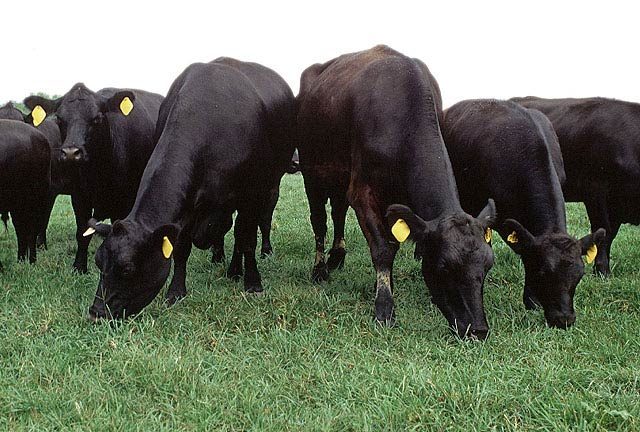
Aberdeen Angus cattle, originally from northeastern Scotland, are polled (naturally hornless) and typically black, though a red variant exists. In Germany, both the imported Aberdeen Angus and a domestically developed composite called Deutsches Angus (German Angus) are present.
German Angus
The German Angus is a composite breed developed in Germany from crosses between Aberdeen Angus and German dual-purpose breeds, including Fleckvieh and German Black Pied. The resulting population was selected for a combination of beef performance and adaptation to German farming conditions. The breed association, Bundesverband Deutsches Angus e.V., maintains its studbook and publishes breeding values.
German Angus cattle are polled, which eliminates the need for disbudding and reduces handling complexity. They are often found in cow-calf operations on permanent grassland, where low input costs and minimal labor per head are priorities.
Limousin
The Limousin originates from the Limousin region of central France and is characterized by a golden-red coat, fine bone structure, and high meat yield relative to live weight. In Germany, Limousin cattle are present in suckler herds in several regions, with an active breeder population represented by the Bundesverband Limousin e.V.
The breed is notable for a high dressing percentage and a lean carcass profile, which has attracted interest from processors targeting premium retail markets. Limousin bulls are also used as terminal sires in crossbreeding programs where leanness and fine bone structure are desired.
Crossbreeding and Commercial Beef Production
A significant proportion of beef cattle slaughtered in Germany are not purebred but rather crossbred animals. Common crossing strategies include:
- Beef bulls (Charolais, Limousin) on Holstein-Friesian dairy cows to produce F1 beef calves
- Hereford or Angus as first-cross sires on native breeds for calving ease
- Rotational crossbreeding within suckler herds to maintain hybrid vigor
The economics of crossbreeding in German beef production depend heavily on slaughter price differentials between breeds and the cost structure of the operation. EU cattle carcass classification uses the EUROP grid, which scores carcasses for conformation and fat coverage; breed choice influences the expected classification outcome.
Performance Testing Framework
Germany maintains a network of centralized testing stations for beef bulls. Bulls from registered herds may be submitted for testing, during which standardized daily gain, feed intake, and conformation data are collected. Results are incorporated into official breeding value estimates.
Field data from commercial herds, including weaning weights, 365-day weights, and calving interval records, supplement station data. The integration of genomic information has been adopted for some beef breeds, though the reference populations are smaller than in dairy, limiting the precision of genomic predictions.